
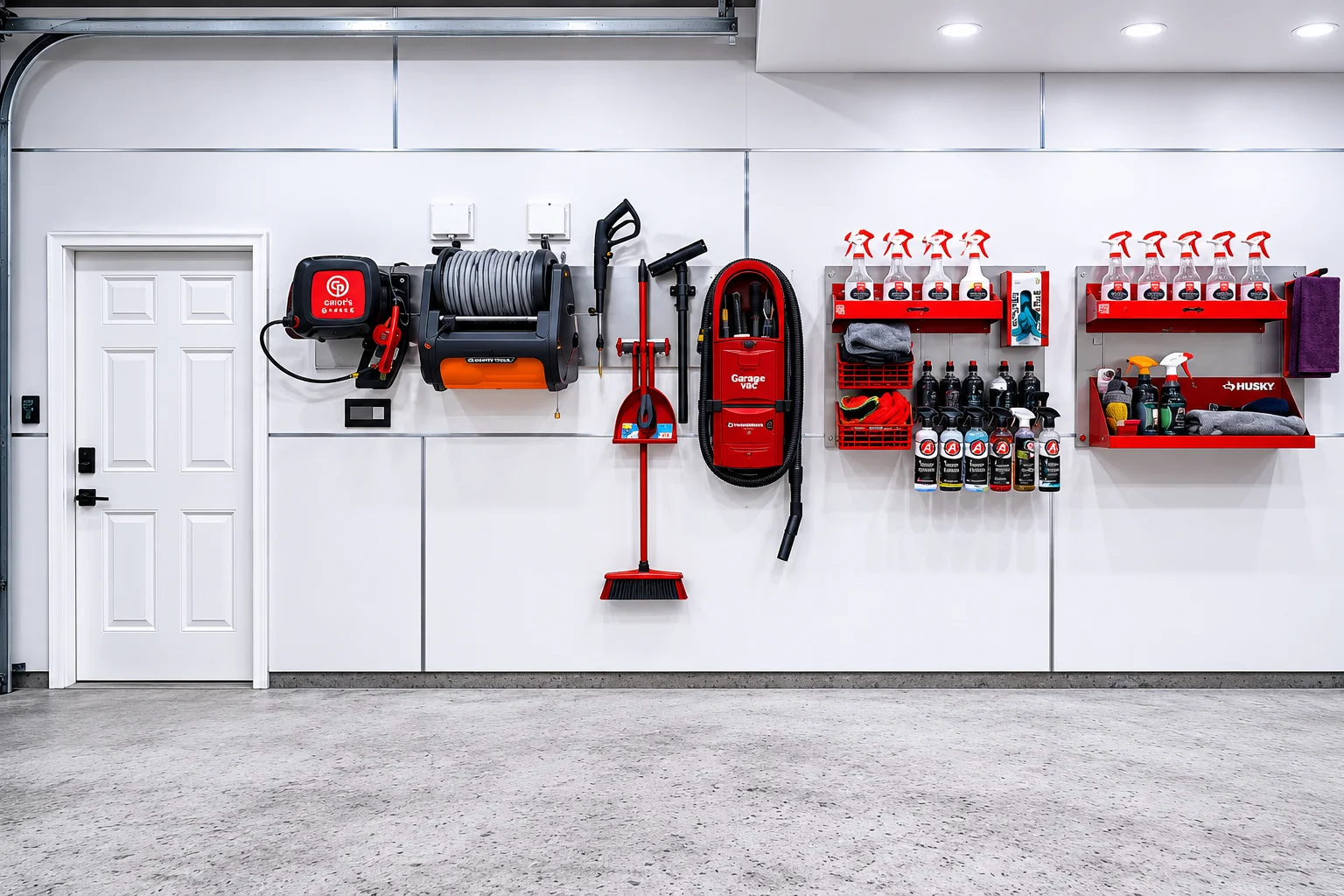
DIY garage organization using IKEA stainless steel panels, floating wall mounts, a wall-mounted pressure washer, retractable hose reel, air compressor, garage vacuum, and frost-free water outlet.
This IKEA hack turns IKEA NOGSTA stainless steel panels into a sleek, wall-mounted garage car wash and detailing station — modern, space-saving, and built on a budget. If you love a good IKEA hack and you’ve got a garage, this one’s for you.

Part of my Custom Detached Garage build series. This is one section of a much bigger project — I’ll be breaking down each feature (foundation, drainage, framing, siding, and more) in its own post. This is how I did it — not the only way — so borrow whatever works for you. And always check with your local building code authorities before you start.
I’ve dreamed about having a real garage car wash — with a floor drain and everything — basically my whole life. So when I designed my custom six-car detached garage, a wall-mounted wash and detail center was non-negotiable. I wanted all my supplies, the vacuum, air compressor, power washer, and hoses stored neatly in one place with a clean, modern look. Nothing I found online matched my vision, so I designed my own.
The IKEA Hack That Started It All
I discovered IKEA’s NOGSTA stainless steel cover panels, originally made for kitchens. They come in 25×30 and 15×30 sizes, which limited my layout, but the material is perfect: real stainless steel wrapped over a wood core — durable and easy to clean. Combined with two-inch marine-grade glass-railing standoff brackets, I created a floating wall-mount system that looks commercial-grade but cost a fraction of custom fabrication.
A quick note since people always ask: these are interior kitchen panels, not exterior-rated. That’s fine here because they live inside an enclosed, water-resistant bay and only ever see a little splash — the heavy spraying happens outside (more on that below). The exterior-rated part is the bay itself — the siding, trim, and doors — not the panels.
Honestly, the whole idea — pulling all the equipment together onto these floating stainless panels — is what makes it feel unique and easy to live with. It’s not just the parts; it’s the way it all floats and looks together.


Get the IKEA NOGSTA panels (both sizes):
- NOGSTA Cover panel, stainless finish, 15×30″ — Article number 405.315.92 — View on IKEA
- NOGSTA Cover panel, stainless steel, 25×30″ — Article number 205.315.93 — View on IKEA
Note: these fit SEKTION base cabinets and can’t be cut to size, so pick the size that matches your layout. Prices vary — the 15×30″ was around $40.80 when I bought mine.


Location & Why Everything Is Exterior-Rated
Location planning mattered as much as the build. I designed a drive-through bay that opens to the backyard, and I placed the wash center close to that door. Because water lives here — and because we sometimes leave the doors open for backyard access — the walls in this bay are not drywall. Everything is rated for exterior use: exterior siding, exterior trim, and exterior-rated doors. The whole box is built to shrug off water.


The outlets are GFCI-protected and sit inside fully enclosed weatherproof boxes with lids, mounted up high so splashing water can’t reach them. And before any siding went on, I bolted two horizontal 2×10 backing boards into the framing exactly where the panels would hang, so the heavy gear has real structure to carry it — not just four standoffs.
Prep Is Everything
Before the walls were closed up, I ran a dedicated 30-amp electrical line and a frost-free water line. For the panel holding the heaviest gear, I sandwiched PVC backer boards in the standoff gap between the panel and the wall. That way the power washer and compressor bolt through the panel, through the PVC spacer, and into the framing — not just hanging off the brackets. I also pre-marked all my standoff screw locations before painting so I wouldn’t lose them under fresh coats.


The Equipment (And Where to Get It)
Here’s exactly what I used and why. I’ve linked the gear below so you can grab the same pieces if you want to copy the setup.
- Chicago Pneumatic WALL-AIR retractable air compressor — A wall-mounted compressor that folds flat against the wall when not in use. Plenty of air for inflating tires and cleaning interiors, lightweight but sturdy, and the red accents match the whole theme. I pair it with a Milton digital tire pressure gauge for quick, accurate fills.
- Giraffe Grandfalls 3700 PSI power washer with 100-ft hose — A beautiful piece of equipment. I mounted it right next to the water outlet, so there’s only about 20 inches of hose between the outlet and the washer — no tangled hoses all over the floor. It’s got a reddish accent that ties into the rest of the wall.
- Garage vacuum (red) — Designed specifically for garages: flat profile, plenty of attachment ports, and quiet. I genuinely love this thing.
- Brooms & detailing brushes.
- Giraffe 150-ft retractable hose reel — Mounted at the far end of the 32-foot bay so I can reach the back side of the garage and the backyard. Keeping it indoors keeps the hose dry and out of the sun, so it lasts a lot longer.
- Detail accessories — Griot’s Garage red bottle holders, a Husky shelf, a Milwaukee towel holder mounted vertically, red disposable glove dispensers, and Milwaukee tool baskets for drying rags.
The Full Setup


The Water Outlet
The water supply is a built-in frost-free Aquor water outlet (the Aquor House Hydrant). It sits inside the wall and only recesses about two inches deep — my wall is only four inches deep, so I used the shortest model they make, leaving room behind it for the elbow. All the valves are inside the wall and insulated, so it’s truly frost-free and looks clean against the modern wall we built. It came with a grey cover, but since this outlet is indoors I removed it — it looks cleaner and more built-in without it.


The Build & Gear Layout
I laid everything on the floor first — equipment still wrapped in IKEA’s protective film — and worked out the most efficient arrangement before drilling a single hole. The main station got two panels side by side holding the power washer, the folding compressor, the garage vac, and brooms. The detail center used two more panels for the bottle holders, shelf, towel holder, glove dispensers, drying baskets, detailing brushes, and an extra bottle-holder bracket. At the far end, the retractable hose reel handles quick rinses.


Why the Drain & Exterior Siding (Inside vs. Outside Washing)
In winter, I pull the car inside and rinse off the road salt right there in the bay. That’s exactly what the 10-foot floor drain and the exterior siding are for — the water has somewhere to go, and the walls are built to take the splash. A quick salt rinse in a heated bay beats freezing outside, and it protects the car all season.
In warmer weather, I pull the car outside next to the garage, where there’s a lot more room to move around it for a full wash and detail. The power washer hose is 100 feet, the Giraffe reel is 150 feet, and the air-compressor line is about 50 feet, so everything reaches easily. Inside, I still clean and vacuum year-round.
So the drain and the exterior build aren’t overkill — they earn their keep every winter, and the long hoses cover the warm-weather washes outside.


⚠️ Disclaimer
The content on HOMEJECT is provided for informational and entertainment purposes only. The projects, ideas, methods, tools, materials, and techniques shown reflect my personal experiences and opinions based on my own DIY projects.
This content is not intended to serve as professional construction, engineering, architectural, electrical, plumbing, structural, safety, legal, or code-compliance advice. It should not be considered a step-by-step guide or instruction manual for any project.
Every property, structure, situation, skill level, and local building code is different. Before attempting any project, consult qualified professionals when appropriate and verify all applicable codes, permits, regulations, and safety requirements in your area.
By using information found on this website, you acknowledge that any actions you take are at your own risk. HOMEJECT and its owner assume no responsibility or liability for any injury, damage, loss, or issues that may result from the use of information presented on this site.
Final Thoughts
The combination of stainless steel and red accessories against white garage walls genuinely looks like a professional detailing shop. The floating panel design means no ugly lag-bolt holes in my exterior-rated walls — if I ever want to swap equipment, I just rearrange the panel instead of patching dozens of holes.
Protective tip: leave IKEA’s factory film on until the very last step. It saves you from drill swirl, fingerprints, and scratches during installation.
This IKEA hack gave me a showroom-worthy detail center on a DIY budget — and I’d do it again in a heartbeat. More sections of the custom garage build are coming soon.


Not Just for a Car Wash: Endless Wall-Mounted Organization Ideas
Even if a car wash isn’t your goal, here’s the real takeaway: at its core, this is a modern, space-saving wall-mounted organization system that works almost anywhere. The car wash is simply how I chose to use it.
The same NOGSTA panels and standoff setup can organize a workshop, a home garage, a mudroom, a utility wall, a hobby bench, or a tool corner. Mount small shelves, hooks, brackets, bins, pegboards, magnetic strips, equipment, sports gear, cleaning supplies, or everyday accessories — the stainless surface keeps it looking clean and modern, and the floating design means you can rearrange everything without patching a wall full of holes. The possibilities are nearly endless — just mind the weight: the panels themselves aren’t rated for heavy loads. Keep them to lighter shelves, hooks, and accessories, and for anything heavy, add a backer board behind the panel and drive lag screws through into the studs (the way I mounted the compressor and power washer).
So whether you want a garage car wash, a tidy shop wall, or just a sleek place to corral the clutter at home, this is a flexible, good-looking, budget-friendly way to do it.
Garage Wall Organization System Ideas
If you’re hunting for a garage wall organization system, this approach scales to almost any need. It works as a garage storage wall for tools and gear, wall-mounted garage storage for cleaning supplies, or a tidy command center for everything that usually ends up on the floor. Because the panels float on standoffs, you can build out a full garage organization wall and reconfigure it anytime — add shelves, hooks, baskets, or racks as your needs change, without ever patching a hole.
Tools & materials: Drill/driver, level, stud finder, pencil, measuring tape, marine-grade standoff brackets (2″), 3½” lag bolts, PVC backer boards, 2×10 backing boards, frost-free water outlet, GFCI outlets + weatherproof enclosures.
Shop This Build
- IKEA NOGSTA panel 15×30″
- IKEA NOGSTA panel 25×30″
- Standoff brackets (2″)
- Chicago Pneumatic WALL-AIR compressor
- Milton digital tire gauge
- Giraffe Grandfalls 3700 PSI power washer
- Giraffe 150-ft hose reel
- Garage vacuum (red)
- Red broom & brushes
- Aquor House Hydrant
- Glove dispensers
- Bottle & brush holder shelf
- Towels
- Griot’s Garage bottle rack
- Husky red wall shelf
- Milwaukee PACKOUT roll holder
- Milwaukee PACKOUT wall basket
Safety first — before you drill or screw into any wall: always confirm there are no water lines or electrical wiring hidden inside it. Use a stud finder with live-wire/pipe detection, kill the power to the circuit at the breaker, and when in doubt, open the wall or call a pro. A standoff screw in the wrong spot can hit a pipe or a live wire — not worth the risk.
Codes & professionals: any electrical or plumbing work should follow your local building codes and permit requirements, and be done by a licensed electrician or plumber where required. What worked for my setup may not meet code in your area.
This car wash station is part of my larger detached 6-car garage build — see how I planned and designed the whole thing from scratch.
Affiliate disclosure: I’m an Amazon Associate, so the Amazon links above are affiliate links — if you buy through them, I may earn a small commission at no extra cost to you. The non-Amazon links (Griot’s Garage and Home Depot) aren’t affiliate; I’m just sharing where I got those pieces. Thanks for the support!
Disclosure: HOMEJECT is an independent DIY project journal and is not affiliated with, sponsored by, or endorsed by IKEA or any other brand mentioned. Product names such as SEKTION, PAX, KUNGSFORS, DETOLF and BILLY are trademarks of their respective owners, used here for identification and descriptive purposes only (nominative fair use). This post documents a personal build and is not an official installation guide.
Leave a Reply