Tag: outdoor decor

  • Custom Walnut Wall Mount for Kebab Skewers

    Custom Walnut Wall Mount for Kebab Skewers

    Some projects are useful. Some projects are beautiful. And some become instant conversation pieces.

    This one turned into all three.

    I had a handmade set of Armenian shish kebab skewers sitting in a drawer for way too long, and honestly… they deserved better.

    These are not cheap store-bought skewers. Each one is handmade with stainless steel blades and detailed brass animal heads on the handles. Every skewer has its own personality, and the craftsmanship is incredible.

    So instead of hiding them away, I decided to turn them into wall art.

    The Idea

    The inspiration actually came from old medieval sword displays mounted on castle walls. Same concept. Different vibe.

    Instead of swords, I wanted a luxury-looking wall mount that could hold my custom BBQ skewers while still being practical enough to grab and use anytime I fire up the grill.

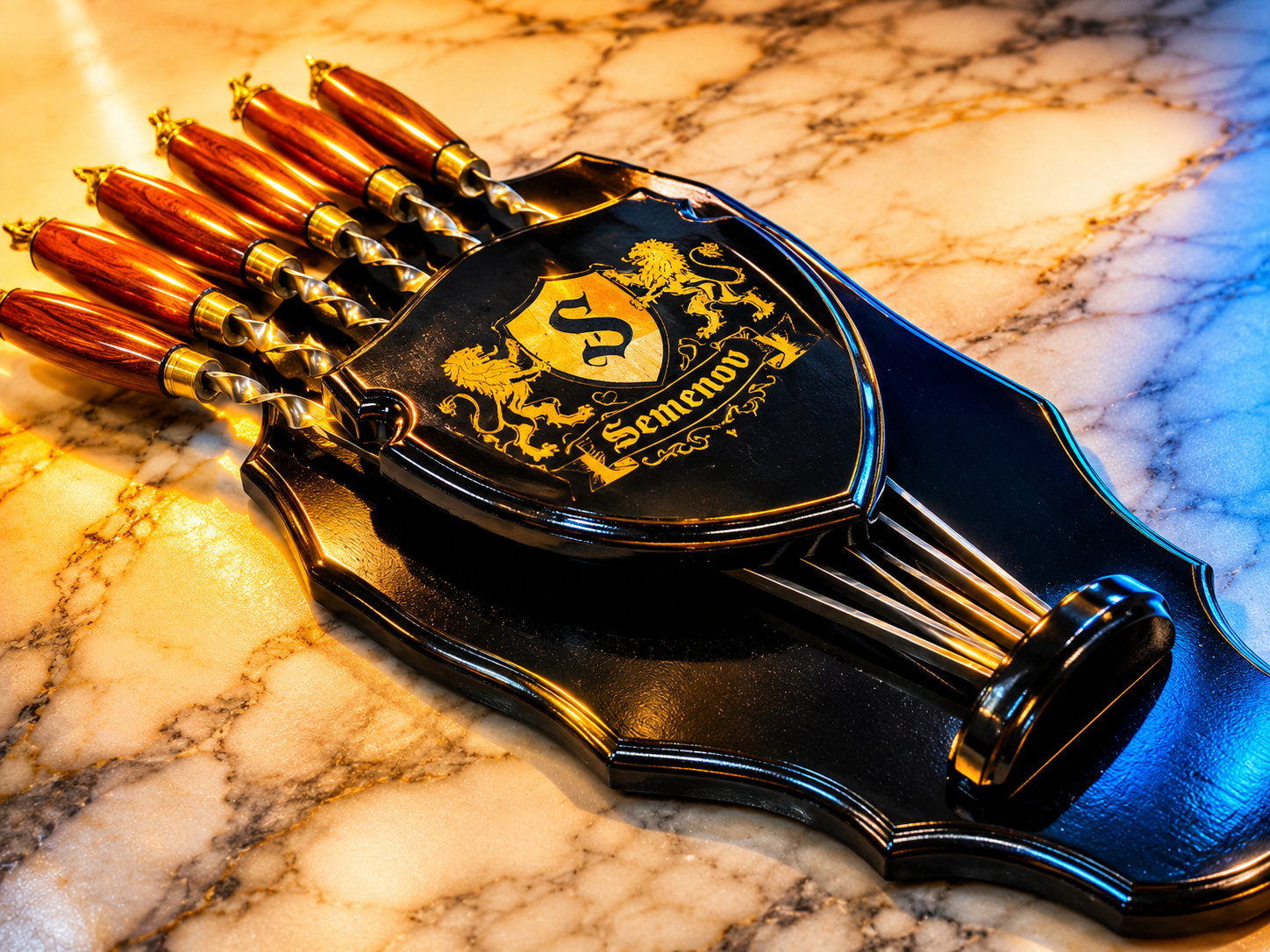
    And because this project is personal to my family, I added an engraved Semenov family crest in the center.

    That small detail completely changed the feel of the project. It stopped looking like a storage rack and started looking like something custom-made for a luxury outdoor kitchen.

    Building the Wall Mount

    I used walnut wood for the base because the deep grain and dark color matched the brass handles perfectly.

    After cutting and shaping the board, I engraved the crest into the center piece and started layering stain to bring out the natural walnut texture. The engraved details were picked out in Glidden Metallic Tones silver paint to make the crest pop against the dark wood.

    Once the stain and silver paint had fully dried, I sealed everything with two coats of Spray Max 2K Clear Coat. That is the same two-part automotive clear used on car bodywork — chemically cured, UV stable, and rated for outdoor exposure. Since this display lives outside on the patio under the roof, the walnut is fully protected from moisture, heat, and changing weather. The glossy finish also gave it that rich, almost furniture-quality look.

    The final setup holds all six skewers individually so they slide in and out easily while still looking clean and organized on the wall.

    The Best Part

    The brass catches sunlight differently throughout the day. In the morning it looks warm and classic. At sunset it almost glows.

    At night, under patio lighting, the whole display looks like something from a luxury steakhouse. And every single person who sees it asks about it.

    Final Thoughts

    This ended up being one of my favorite smaller projects because it combines culture, craftsmanship, grilling, and design into one piece. It is functional. It is personal. And it completely transformed a simple set of skewers into something worth displaying.

    If you have custom BBQ tools, handmade kitchen pieces, or anything with sentimental value sitting hidden in a cabinet, try building a custom display for it.

    Tools & Materials

  • IKEA KUNGSFORS Outdoor Kitchen Hack: Stainless Wall Storage

    IKEA KUNGSFORS Outdoor Kitchen Hack: Stainless Wall Storage

    When I built out my outdoor bar and coffee room, I ran into a common problem: not enough wall space. I needed a storage system that could hold shelves, knives, and cups without looking bulky or cluttered. That led me to a simple IKEA hack that came together beautifully.

    IKEA KUNGSFORS outdoor kitchen wall storage

    The KUNGSFORS Rail System

    IKEA’s KUNGSFORS is a modular kitchen wall system made up of vertical suspension rails, horizontal crossbars, and accessories you can mix and match. What sold me on it was the material — stainless steel. That means it holds up perfectly outdoors, which is exactly what I needed. It also has a clean, minimal look that fits a luxury outdoor space without feeling like an afterthought.

    I installed two vertical suspension rails with 22-inch horizontal crossbars and added a magnetic knife bar across the top. One of the best features is that all the screws are hidden behind cover bars. If you want to reposition anything, you just slide the cover off, adjust, and snap it back. Super flexible.

    KUNGSFORS magnetic knife rack and rail crossbar detail

    The Custom Hook Hack

    Here is where it gets creative. I wanted a dedicated bar for hanging my Moroccan espresso cups, so I bought a separate KUNGSFORS rail and a set of six magnetic clips from the same collection. The clips come with small built-in neodymium magnets, which is great, but the magnets alone were not strong enough for me to trust them long-term — even with lightweight cups.

    I could not drill through the clips because the magnets inside are fragile and would crack. So I came up with a workaround. I positioned each clip at an angle so the cups would hang vertically, then bonded them permanently to the rail using J-B Weld epoxy.

    Moroccan espresso cups on KUNGSFORS rail

    The trick to getting a clean result is prep work. I laid down masking tape first to create straight guide lines. Then I cleaned both the clips and the rail with solvent before applying the epoxy. I wiped away any excess J-B Weld immediately so there would be no messy residue. Once cured, the bond is incredibly strong — and combined with the built-in magnets, those hooks are not going anywhere.

    Finished KUNGSFORS rail with magnetic clips

    The Finished Look

    With the main KUNGSFORS rail setup on one side and the custom cup bar right next to it, the whole wall has a cohesive, polished feel. Everything is stainless steel, everything matches, and it all works perfectly in an outdoor environment.

    If you have been thinking of the KUNGSFORS system only for indoor kitchens or pantries, think bigger. It is an excellent solution for outdoor kitchens, bar areas, and coffee stations. Stainless steel plus a little creativity goes a long way.

    Tools & Materials

    IKEA KUNGSFORS parts used:

    • KUNGSFORS Suspension rail, 31½”, stainless steel — 803.348.58
    • KUNGSFORS Rail, 22″, stainless steel — 403.349.16
    • KUNGSFORS Magnetic knife rack, 22″, stainless steel — 403.349.21
    • KUNGSFORS Magnetic clip, stainless steel (set of 6) — 003.349.23

    Other supplies:

    Watch the Build

    Watch the KUNGSFORS outdoor kitchen build on YouTube
    ▶ Watch the full build on YouTube
  • How I Built a Floating Outdoor Photo Gallery on My Patio Wall

    How I Built a Floating Outdoor Photo Gallery on My Patio Wall

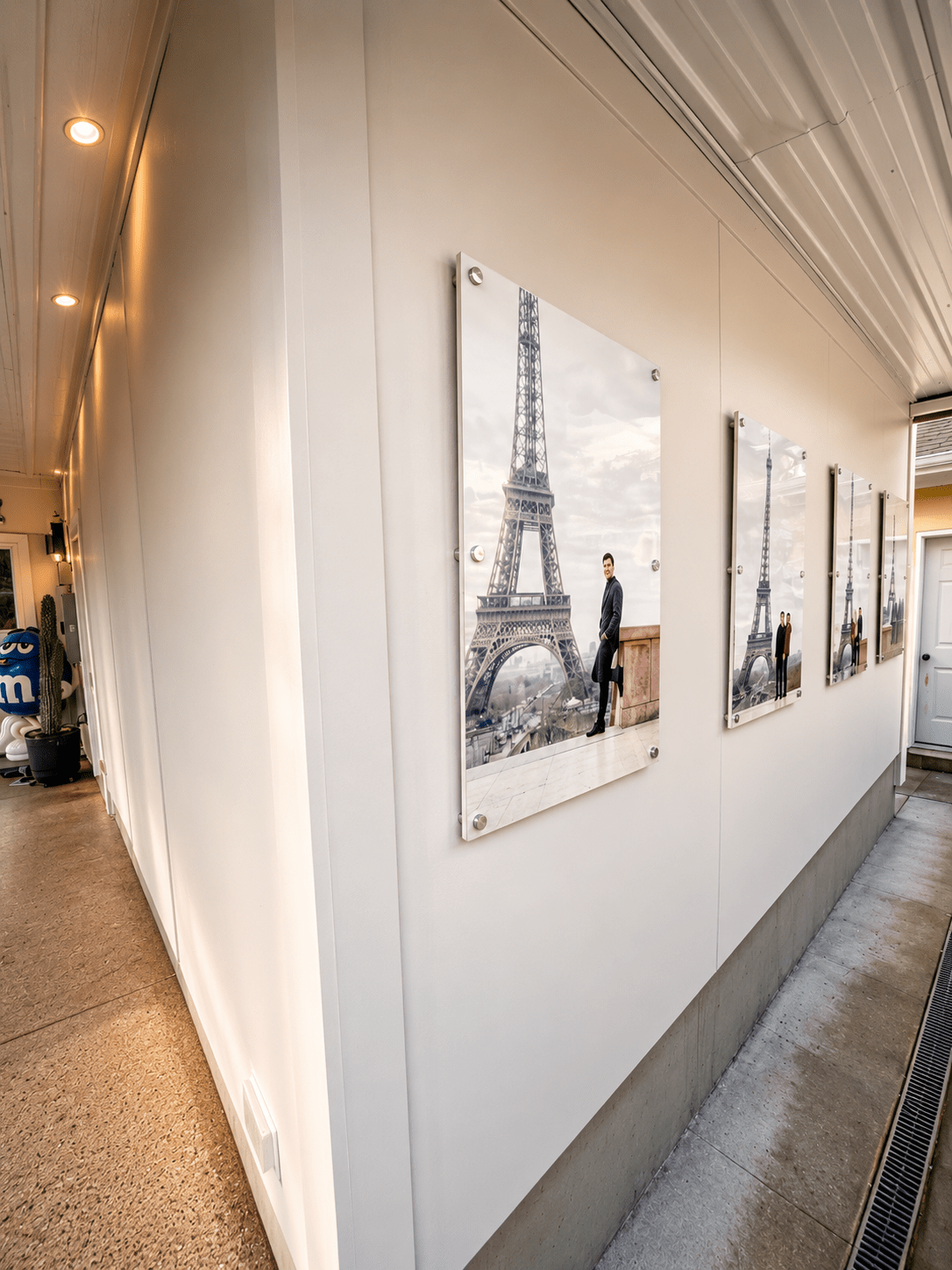
    A few months ago, I had this idea stuck in my head: take the black-and-white professional photos my wife and I shot in Paris six years ago and turn our outdoor patio wall into a gallery. Here’s exactly how I pulled it off.


    Why Aluminum Prints Beat Glass and Canvas Outdoors

    I found a company online that prints photos directly onto thin aluminum sheets. I ordered four prints at 24×36 inches each. Aluminum is the right choice for outdoor use — it won’t warp like paper or canvas, and it holds up against the elements far better than glass.

    Glass was my original plan, but it was expensive, fragile, and tough to work with. Aluminum was the clear winner.

    Building the PVC Backing

    To give each print a more finished, professional look, I picked up half-inch PVC board from Home Depot. PVC is lightweight, weather-resistant, white, and incredibly easy to cut.

    I sliced it into strips for the frame edges and hand-filed the corners for a clean fit. Then I used Gorilla Glue outdoor adhesive, sprayed the back surface of the PVC, pressed the aluminum print onto it, and laid everything flat on the floor overnight to cure.

    Mounting with Standoff Brackets for the Floating Effect

    This is where the magic happens. I ordered standoff brackets — the kind typically used for floating glass signage. Mine were one-inch diameter caps with a 45mm (roughly one-inch) standoff from the wall, which creates that gorgeous floating effect without sticking out too far.

    I drilled four holes per picture, about an inch from each corner. Started with a 3/8-inch bit, then enlarged to 1/2-inch for a little play during installation.

    Pro tip: lay masking tape over the photo surface before drilling so you don’t scratch the print. Peel it off right before final install.

    For mounting the standoff barrels into the wall, I used 1-1/4″ exterior-grade screws. They’re rated for outdoor use, won’t rust, and the length gives plenty of bite into the wall structure without going so deep that you risk hitting anything behind it.

    The stainless standoff barrels create the floating effect by spacing the artwork slightly away from the wall.
    Sam came to Hi …

    On the wall, I measured equal spacing, making sure the height was visible from every angle of the deck. I started each photo by holding it against the wall without the barrel caps, tracing two pilot holes at the bottom. Drilled those, mounted the bottom brackets, hung the photo, then climbed up and repeated for the top.

    Four of my photos ended up needing six brackets each because the centers were bowing slightly. Two extra standoffs in the middle solved that completely.

    The Finished Look — and the One UV Mistake to Avoid

    The result is stunning — four floating black-and-white Paris photos on the patio wall that look like a professional installation. The brushed aluminum standoffs complement the prints perfectly.

    One critical tip: mount these away from direct sunlight. My wall faces east and sits under a balcony overhang, so the prints get ambient light but no harsh UV exposure. Aluminum prints will fade in direct sun over time. Find a covered or shaded wall and you’ll enjoy them for years.

    Watch the full build on YouTube:

    This project brought real character to our outdoor space. If you’ve got photos you love, get them printed on aluminum and give this a try.


    Tools and Materials

    Here are the supplies I used for this build, from Amazon and Home Depot:


    FAQ

    Will aluminum prints fade outdoors?

    Yes, eventually — but only with direct UV exposure. Mounted under a covered patio, balcony overhang, or on a shaded wall, quality aluminum prints will hold their color for years. Direct south- or west-facing sun is what kills them.

    How far should standoff brackets sit from the wall?

    A 45mm (roughly one-inch) standoff is the sweet spot for outdoor wall art. It creates a clear floating effect and a visible shadow line without the print feeling like it’s hovering awkwardly off the wall.

    Can I install standoff brackets on stucco or brick?

    Yes. Use a masonry bit sized for the standoff anchor, and drop in a plastic anchor or sleeve before threading the standoff barrel. The same install logic applies — bottom brackets first, then top.


    More from the patio: The Patio · Outside

  • How to Anchor Artificial Palm Trees in Planters (So They Won’t Tip Over)

    How to Anchor Artificial Palm Trees in Planters (So They Won’t Tip Over)

    Artificial palm trees are one of the easiest ways to transform a patio, deck, or backyard into a clean, resort-style space — without watering, trimming, or seasonal upkeep. They look great on covered patios, by pool decks, on apartment balconies, and even on Midwest backyards where real palms can’t survive winter.

    The challenge? Most artificial palm trees tip over in wind or look unstable in large planters. A 6-foot faux palm in a basic pot is top-heavy, and even a moderate gust will send it across the patio.

    This guide shows exactly how to anchor an artificial palm tree in a planter using a lightweight foam-and-brick system that keeps it solid, movable, and professional-looking. Same method works for fake palm trees, faux fiddle leaf figs, artificial olive trees, and any other top-heavy outdoor faux plant.

    Artificial palm tree laying on stamped concrete patio next to empty planter, ready for assembly
    Before assembly — the palm laid out on the concrete patio next to the empty planter.

    What You’ll Need

    • Large sturdy planter with drainage holes
    • Rigid exterior-grade foam insulation (2–3 inches thick)
    • Bricks or heavy stones
    • Utility knife
    • Decorative pebble rocks (black or white, 1–3 inches)
    • Masonry or concrete sealer (optional, for seasonal refresh)

    Step 1: Choose the Right Planter and Palm

    Start with a large, heavy-duty outdoor planter. Oversizing is critical. The extra volume gives you room to build a counterweight base, prevents tall palms from tipping in wind, and creates a more high-end visual scale on the patio.

    Pro tip: Keep artificial palms under 7 feet tall for outdoor use. Taller faux palm trees catch more wind and become unstable, even with a heavy base.

    Step 2: Build a Lightweight but Stable Base

    Instead of filling the entire planter with rocks (which can exceed 200 lbs), use this layered system: rigid foam sheets at the bottom, stack 2–3 layers to build height, then add bricks or heavy stones on top.

    This creates a strong support platform with enough weight for stability (70–100 lbs ideal), and a planter that’s still movable when needed for winter storage or patio rearranging.

    Step 3: Lock Everything in Place with Foam Wedges

    Once your palm is positioned on the brick base, cut small foam pieces with a utility knife and force them tightly into every gap — around the base, between the bricks, and against the planter walls.

    This step is critical. The foam compresses and expands slightly, creating a tight, friction-locked system. Test it: grab the trunk and shake it. If the entire planter moves as one unit — you did it right.

    Styrofoam wedges packed between bricks at the base of an artificial palm to prevent wobble in wind
    Foam wedges forced into every gap between the bricks and the planter wall.

    Step 4: Finish with Decorative Rock

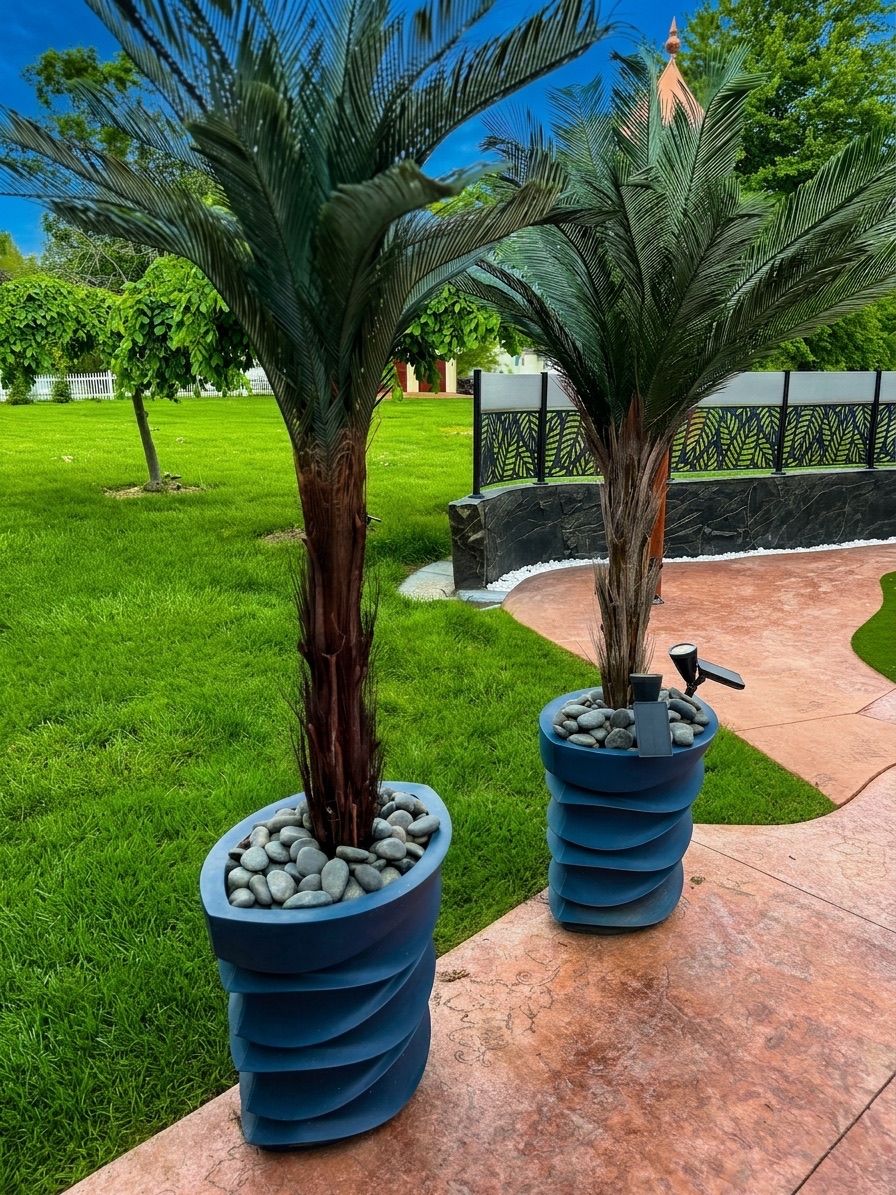
    Set the palm base about 2 inches below the rim. Cover with decorative pebbles — black river rock for bold contrast, white pebbles for a clean modern look. Make sure no foam or bricks are visible.

    Finished artificial cycas palm with river rocks on top of foam and brick base in tall blue planter on stamped concrete patio
    Top off with river rocks — foam, bricks, and base disappear under a clean stone surface.

    Pro Tip: Restore Faded Rocks

    Over time, decorative rocks lose their color from sun and dust. To refresh them, use a brush (not spray) and apply masonry or concrete sealer lightly. Result: a rich, wet-look finish that lasts about a year.

    Winter Storage Tips

    Artificial palms are low maintenance, but for longevity in cold climates: cover with a large bag or tarp, store under a roof or covered area, and avoid prolonged exposure to snow and ice. Because the planter is movable (not 200 lbs of solid rock), winter prep actually happens.

    Why This Method Works

    • Prevents tipping in wind
    • Keeps planter weight manageable
    • Creates a clean, professional finish
    • Lets you move the planter for winter or patio rearranging
    Old English sheepdog standing on stamped concrete patio next to an artificial palm assembly
    Even the dog can’t believe they’re real.
    Watch the full build on YouTube Shorts.

    Frequently Asked Questions

    How tall can an artificial palm tree be in a planter outdoors?

    Keep it under 7 feet. Above that, wind catches the canopy and even a heavy planter starts to lose the fight. For taller looks, group two or three shorter palms together.

    Can I use sand or dirt instead of bricks?

    You can, but bricks let you stack precisely, lock with foam wedges, and remove the tree later if you need to. Sand and dirt also retain water, which can rot the bottom of a faux palm trunk over time.

    Why not just fill the whole planter with rock?

    You’ll end up with a 150–200 lb planter you can’t move when winter hits or when you want to rearrange the patio. The foam-and-brick method gives you the same stability without the dead weight.

    Will the foam break down in the sun?

    The foam is buried under bricks and rock with no UV exposure. The top decorative layer hides everything.

    Do I need drainage holes if the tree is artificial?

    Yes. Rain still gets in, and you don’t want standing water against the foam, the bricks, or the bottom of the tree base.

    Will artificial palm trees fade in the sun?

    Cheaper faux palms fade in 1–2 seasons. Look for UV-resistant or UV-protected artificial palms when shopping — they cost more upfront but hold their color for 5+ years outdoors.

    Can I leave artificial palms outside in winter?

    Short cold spells are fine. For sustained freezes or heavy snow, cover with a bag or move under a roof — UV-treated plastic gets brittle in extreme cold and can crack.


    Final Result

    You get a stable, wind-resistant artificial palm setup, a high-end patio aesthetic, and zero ongoing maintenance.

    Homeject Tip: Mix artificial palms with real plants and layered lighting to create a fully designed outdoor space — not just decoration.


    Related Homeject Posts

    • 👉 The “All-Inclusive” Patio overview — see how the palms fit into the full backyard build
    • 👉 Banana trees in the Midwest — the live tropical companion to the artificial palms (coming soon)
    • 👉 Custom decorative concrete patio — what’s underneath all of it (coming soon)